
Key Benefits of Acoustic Panels for Power Generation Enclosures
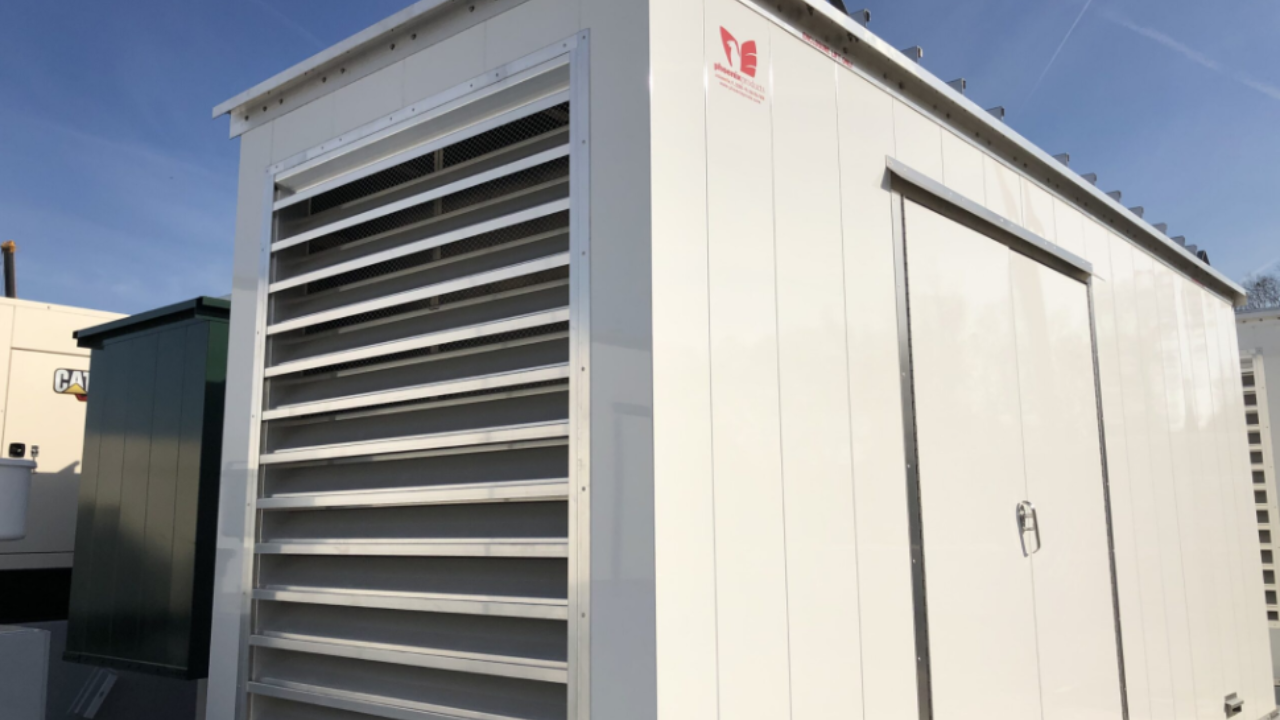
A generator enclosure can have a substantial shell and still deliver less installed noise reduction than its wall construction suggests. Bare interior surfaces reflect sound back into the enclosure, increasing the acoustic energy that reaches ventilation openings, doors, penetrations, and enclosure walls. Treating internal absorption as an accessory separates two acoustic functions that need to work together if the complete enclosure is to meet its noise-control target.
Why Can a Strong Enclosure Shell Still Leak More Noise Than Expected?
An enclosure wall controls only one part of the sound path. Transmission loss is the reduction in sound energy as sound passes through a barrier or enclosure assembly. A wall with substantial transmission loss can effectively restrict sound traveling directly through it.
The generator, however, operates inside a confined space. Reverberation is the persistence of reflected sound within an enclosed space after acoustic energy interacts with surrounding surfaces. Bare metal walls, ceilings, doors, and other hard surfaces reflect part of the sound produced by the engine, cooling fan, radiator, and associated equipment back into the enclosure.
Those reflections contribute to the sound pressure level, the measurable acoustic pressure at a specific location. The resulting internal sound field contains both direct and reflected energy. A wall rating alone does not describe the complete acoustic condition inside the enclosure or how that sound field will interact with ventilation openings, doors, seams, and equipment penetrations.
What Does Internal Absorption Actually Change?
Sound absorption is the dissipation of acoustic energy when sound encounters an absorptive material, reducing the amount reflected back into the surrounding space. Inside a generator enclosure, absorption interrupts repeated reflections that would otherwise contribute to the reverberant field.
That is the distinct job performed by properly selected acoustical panels. A dense wall assembly may provide substantial transmission loss, but internal treatment changes the sound field that reaches the wall, openings, doors, and penetrations.
Attenuation is the reduction of sound energy or sound level as it travels through or interacts with a control system. The net attenuation contributed by internal treatment cannot be reduced to one universal number. Results depend on the generator's sound energy at different frequencies, enclosure geometry, absorptive coverage, panel performance, openings, ventilation treatment, leakage paths, and measurement location.
The better engineering question is what internal absorption changes before sound reaches the rest of the enclosure system. Reducing the reverberant field lowers the reflected acoustic energy presented to the paths that still have to control it.
Why Does Ventilation Turn the Enclosure Into a Systems Problem?
Ventilation makes clear why generator enclosure acoustics cannot be treated as a wall-only problem. Standby and prime-power generators require cooling and combustion air, so intake and discharge paths must remain open enough to move the required volume of air.
Those openings can become consequential acoustic paths. Increasing resistance in an airflow path without accounting for cooling demand can create excessive pressure drop, the resistance the ventilation system must overcome as air passes through components such as louvers and attenuators. Acoustic attenuation, opening size, available space, heat rejection, and airflow have to be resolved against the same operating requirements.
Once enclosure dimensions, radiator arrangements, intake and discharge geometry, and service clearances are fixed, the available acoustic options narrow quickly. Early design work preserves more room to meet both airflow and sound-control targets.
Panels and Silencers Solve Different Problems
Interior panels and silencers are complementary because they act on different parts of the acoustic system.
A sound attenuator, also called a silencer, is a component designed to reduce sound traveling through an airflow path while still allowing air to pass through it. Interior panels reduce reflected sound within the enclosure. Silencers reduce sound propagating through a defined ventilation path.
The design has to account for both functions before airflow and attenuation decisions are locked in. Treating one component as a substitute for the other ignores the different mechanisms each is intended to control.
How Does Internal Treatment Change Project Outcomes?
The project benefits of internal acoustic treatment follow from the mechanisms it changes inside the enclosure.
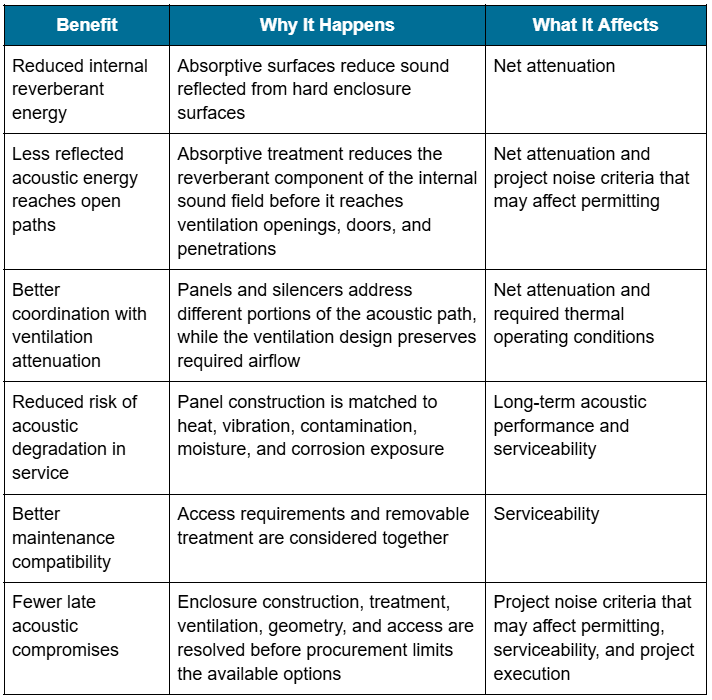
For the project team, the useful question is not whether a panel offers a benefit in general. The more useful question is which physical mechanism produces the required result in this enclosure.
When Does Acoustic Treatment Fail in Generator Environments?
Internal treatment can underperform when its construction does not match the environment in which the generator operates. Heat, vibration, contamination, moisture, cleaning practices, and corrosive exposure can determine whether an absorptive system retains its intended physical and acoustic characteristics.
That concern should not be answered with a blanket claim that acoustic panels are durable. The core, facing, skins, fasteners, coatings, and method of retaining absorptive media need to suit the actual installation. Those factors should also guide the selection of sound absorption panels for other demanding industrial environments.
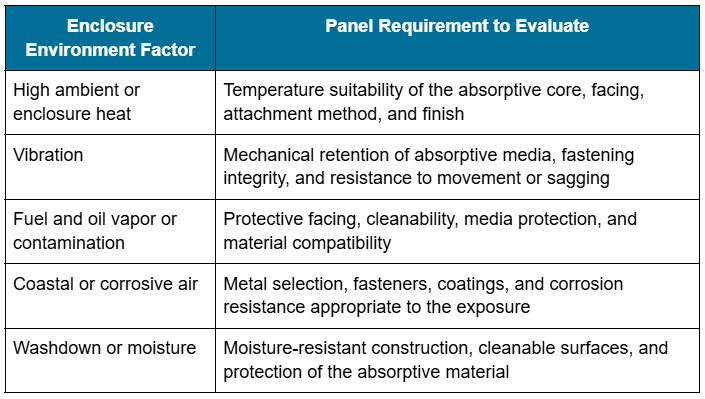
Fuel and oil exposure needs to be part of the material-selection discussion. The facing, core protection, and cleanability have to match the contamination and maintenance conditions expected at the site.
How Does Serviceability Affect Long-Term Acoustic Performance?
Acoustic treatment has to remain compatible with routine generator service. Technicians need practical access to the equipment and its primary maintenance points without dismantling the noise-control strategy whenever routine work is performed.
A treatment layout that interferes with access creates pressure for field modifications. Panels may be altered, removed, damaged, or improperly reinstalled if service requirements were not considered before the enclosure layout was finalized.
Removable panels, acoustical access doors, fastening methods, penetrations, and service clearances should be evaluated as part of the enclosure design. An acoustically effective treatment that cannot coexist with routine generator maintenance is not a complete enclosure solution.
Why Does This Matter More for Critical-Power Projects Now?
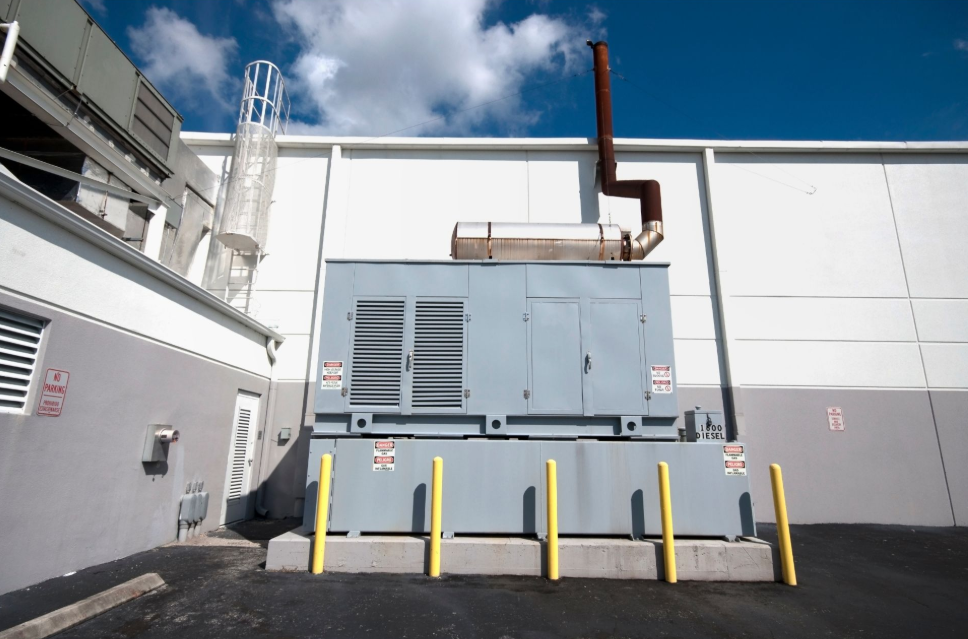
Rapid growth in data-center electricity demand is increasing the planning importance of substantial onsite standby-power systems, particularly on large critical-power projects. That does not make every new generator installation acoustically difficult, but it does put greater attention on projects where power density, cooling, redundancy, maintenance, site constraints, and sound-control requirements must be resolved together.
Noise can also become a permitting and operating issue rather than only an occupant-comfort concern. Some jurisdictions establish noise limits at or near property boundaries, and individual projects may impose additional criteria for nearby residential, institutional, or other noise-sensitive uses.
Internal absorption cannot guarantee compliance with those requirements. It can contribute to the complete attenuation strategy by reducing part of the reflected acoustic energy before it reaches exterior sound paths. The project team still has to establish where noise will be evaluated, what sources contribute to that condition, and what complete-system performance is required. As standby-power requirements become more prominent on large data-center projects, acoustic decisions made inside the enclosure increasingly have to coexist with cooling, access, site constraints, and applicable noise criteria.
When Should Acoustic Treatment Enter the Generator Enclosure Specification?
Acoustic treatment should enter the design process before enclosure geometry, airflow paths, attenuator space, service clearances, and penetration locations become fixed. At that stage, the engineer has considerably more freedom to resolve sound control against the other requirements that determine whether the installation can function as intended.
The process starts with the applicable generator enclosure requirements. The acoustic target then needs to be evaluated alongside ventilation, heat rejection, structural construction, environmental exposure, doors, penetrations, maintenance access, and the available footprint.
Adding absorption later can still improve some installations, but retrofit work has to operate inside geometry and interfaces that are already established. Limited panel area, tight access, short ventilation paths, insufficient attenuator depth, or fixed penetrations may leave fewer effective choices than the project team had during design.
Specification-stage planning preserves options that cannot always be recovered after procurement.
An Integrated Enclosure Strategy Starts Before Procurement
The same system logic applies when selecting the party responsible for helping resolve the enclosure acoustics. Dynasonics can support that discussion with generator enclosures, acoustical panel options, airflow-attenuation components, access features, and broader equipment enclosures selected around project requirements.
That gives the project team a way to address the enclosure shell, internal treatment, airflow attenuation, and service access during the same design discussion. It does not eliminate the need for project-specific engineering, acoustic targets, or ventilation calculations.
Bring Dynasonics into the specification-stage discussion while enclosure construction, airflow, access, and internal acoustic treatment can still be resolved around the same performance target.
Frequently Asked Questions
The following questions address several decisions that commonly arise when internal acoustic treatment is evaluated for generator enclosures.
Do Generator Enclosures Need Acoustic Panels If the Shell Is Already Rated?
A rated shell does not make internal absorption automatically necessary or unnecessary. The shell controls transmission through the enclosure construction, while internal treatment reduces reflected energy inside it. Whether panels are needed depends on the required installed performance and the enclosure's remaining sound paths.
How Much Noise Reduction Do Acoustic Panels Add Inside an Enclosure?
There is no universal added-decibel value. A decibel (dB) is a logarithmic unit used to express sound level or a change in sound level. The result depends on the generator's frequency content, enclosure geometry, absorptive coverage, and the untreated sound paths that remain.
Internal panels should therefore be evaluated as part of the complete acoustic system rather than assigned one generic attenuation value.
Will Acoustic Panels Restrict Airflow or Cause the Generator to Run Hot?
Properly located internal panels do not inherently restrict the generator's cooling airflow. Problems arise when acoustic components or ventilation geometry create excessive pressure drop or reduce the airflow required for cooling.
Airflow, heat rejection, allowable pressure drop, and acoustic attenuation should be resolved together.
What Happens to Acoustic Panels in a High-Heat Generator Environment?
Panel performance depends on whether the construction is suitable for the expected temperature and environmental exposure. The absorptive core, facing, panel skin, fasteners, retention system, and finishes all need to remain appropriate for conditions inside the enclosure.
Heat should be treated as a panel-selection criterion rather than assuming all acoustic treatments have the same temperature capability.
Should Acoustic Treatment Be Specified With the Enclosure or Added Later?
Specifying acoustic treatment with the enclosure provides more freedom to resolve absorption, ventilation attenuation, access, penetrations, and enclosure geometry around the same performance target. Retrofit treatment can still help, but it has to work within decisions that are already fixed.