
9 Ways to Reduce Noise in Office & Improve Acoustics

Every workspace carries its own background hum, voices overlapping, HVAC systems cycling, equipment running nearby. When these sounds add up, productivity and focus suffer. Knowing how to reduce noise in office environments starts with understanding where sound originates and how it behaves within enclosed spaces. A well-designed acoustic plan manages reflections, transmission, and masking to create a balanced sound field instead of chasing silence.
The Impact of Office Noise on Performance
Noise affects communication, concentration, and overall well-being. Studies show that even modest increases above 50 dBA can raise error rates and fatigue over a workday. Open plans, hard surfaces, and shared HVAC systems all amplify this challenge. When you reduce office noise, employees hear conversations clearly without distraction, meetings stay private, and sound levels remain consistent throughout the workday.
The payoff extends beyond comfort, it supports compliance with occupational noise guidelines and improves long-term retention in busy workplaces.
1. Start with an Acoustic Audit
Every improvement begins with measurement. An acoustic audit identifies dominant noise sources and room response.
- Tools such as sound-level meters capture decibel levels (dBA), while reverberation time (RT60) reveals how long sound lingers.
- For most offices, a target RT60 between 0.5 and 0.7 seconds balances clarity with warmth.
- The audit should map noise “hot spots” near mechanical rooms, printers, and open corridors.
Once documented, planners can rank each area by impact and prioritize solutions that deliver the greatest reduction per square foot. Baseline data clarifies how geometry, occupancy, and background noise interact, turning raw measurements into a practical roadmap to reduce noise in office areas methodically.
2. Use Sound Masking for Speech Privacy
Sound masking introduces a uniform broadband signal, often low-level “white” or “pink” noise, to obscure intelligible speech. Properly tuned systems sit around 45 dBA, flattening sound levels across work areas. Still, masking only works when it blends evenly with the room’s existing noise floor. It’s particularly effective where privacy matters: HR offices, healthcare administration, or shared conference zones. Well-designed masking layouts coordinate with ceiling treatments for even coverage (placement and calibration drive results).
3. Add Absorptive Surfaces (Walls & Ceilings)
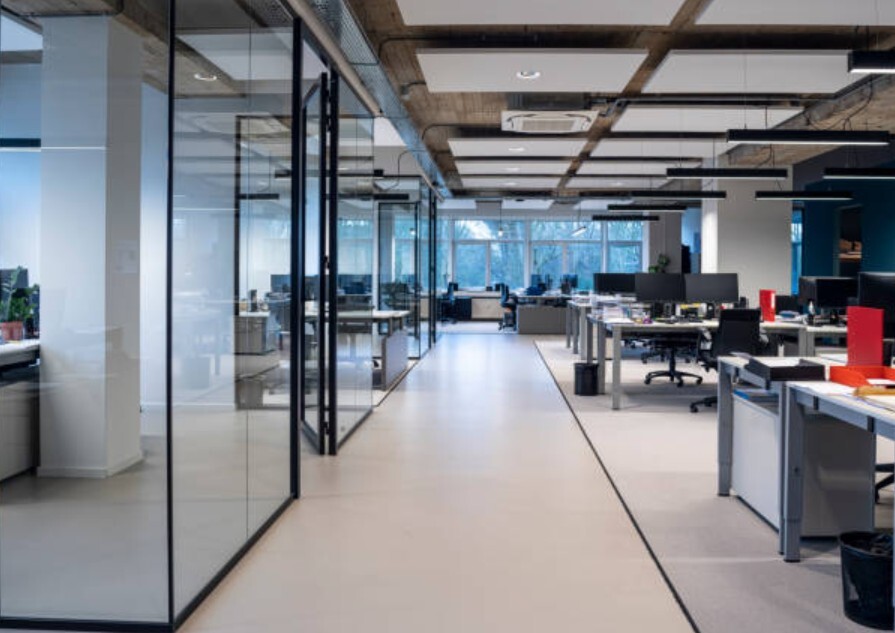
Hard surfaces reflect energy that builds up as reverberation. Wall panels and ceiling baffles with high NRC ratings absorb early reflections and prevent buildup. Hanging acoustic clouds break up ceiling reflections, a simple fix that makes a big difference in large rooms. For open offices with exposed structure, combining vertical baffles and horizontal absorbers yields broadband coverage from 250 Hz to 4 kHz, the range where human speech dominates.
Dynasonics publishes absorption data for applicable acoustical assemblies (for example, modular plenums) with values reported per ASTM C423 / E795; panel systems are engineered for high absorption performance consistent with those methods. Publishing data verified under ASTM standards allows acoustical engineers to model performance precisely before specifying materials. Adding these surfaces is one of the fastest ways to reduce noise in office environments without altering layout.
4. Install Partitions and Acoustic Furniture
Physical separation still matters. Partial-height partitions lined with absorptive material block direct line-of-sight sound paths while maintaining visual openness. The higher the partition and denser the core, the greater its Sound Transmission Class (STC). Ratings of 40–45 are typical for semi-private pods or cubicles.
Acoustic furniture, sofas, screens, and booths, adds localized damping where panels can’t fit. In renovation projects, movable barriers allow flexible reconfiguration without construction downtime. Selecting partitions with both absorptive and barrier properties is a critical step to reduce noise in office layouts and maintain predictable acoustic zones.
5. Control Floor and Structure-Borne Noise
Footfall, rolling carts, and mechanical vibration transmit through rigid structure. Carpet with underlay or rubber backing dampens impact noise, reducing transmission up to 20 dB. For raised-floor systems, resilient pads or damping membranes isolate structural paths between panels and joists.
When upper floors carry conference rooms or mechanical spaces, ceiling isolators below minimize motion transfer to offices beneath. Regular inspection of anchor bolts and hangers keeps isolation effective over time. Addressing structure-borne vibration early prevents resonance that no wall panel can fix later.
6. Address HVAC and Mechanical Noise
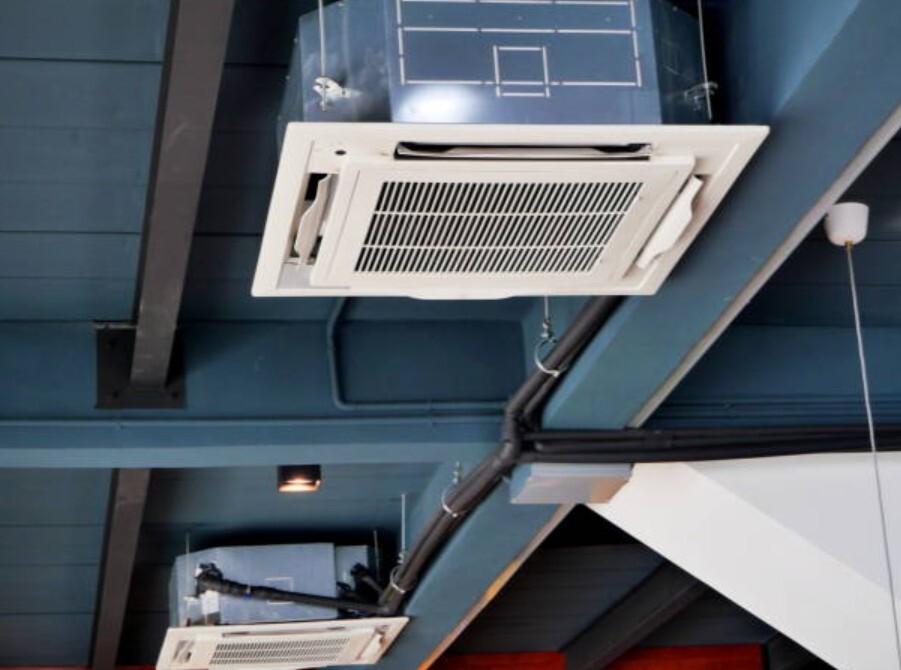
Airflow is a frequent culprit in office acoustics. HVAC silencers are engineered and configurable noise-control components; performance is selected to meet the project’s acoustic and airflow needs, and it should always be specified using lab data. Equipment should rest on vibration isolators, springs or neoprene pads, to prevent transmission through framing. Coordination with mechanical engineers is fundamental so airflow velocity stays within ASHRAE-recommended limits (under 1,000 fpm for supply runs).
Silencer selection and verification are typically based on ASTM E477 lab reports (insertion loss, pressure drop, and self-noise) rather than a single fixed dB value. Dynasonics applies industrial-grade attenuation principles to office-scale HVAC designs, ensuring comfort without restricting airflow.
7. Rethink Layout and Zoning
Noise control also depends on distance and function. Placing break rooms, print stations, and collaboration hubs along circulation corridors creates acoustic buffers around quiet desks. Meeting rooms benefit from central locations surrounded by storage or service zones that interrupt transmission. Ceiling height, column spacing, and furniture orientation all influence how sound travels. As designers integrate these spatial considerations early, they reduce noise in office spaces more efficiently and permanently. Design teams often balance acoustic performance with ceiling height, lighting layout, and mechanical coordination, trade-offs best resolved early in design.
8. Leverage Soft Materials and Green Elements
Textiles, curtains, and upholstered surfaces absorb mid- to high frequencies while softening reflections. Even small additions, acoustic ceiling tiles (NRC 0.70+), fabric wall sections, felt-lined shelving, collectively drop reverberant energy several decibels. Plants add diffusion by breaking up reflections, though their absorption is minimal compared to engineered materials. They still contribute to perceived quiet and complement biophilic design. The goal is layered treatment: dense absorbers for performance, soft furnishings for comfort, and greenery for balance, a combined strategy proven to reduce noise in office settings.
9. Implement a Phased Noise Reduction Plan

Acoustic improvements rarely happen all at once. Begin with measurable quick wins: add panels and masking, then monitor with follow-up sound surveys.
- Compare dBA and RT60 readings before and after to quantify effectiveness.
- Next, address structural and HVAC sources during renovation or maintenance windows.
- Document each step so future designers understand what’s been done and what remains.
A phased plan turns broad goals like noise reduction for office environments into trackable progress supported by data. Post-install testing, comparing pre- and post-treatment readings, verifies that acoustic targets have been met and supports compliance documentation.
Engineer a Quieter Office with Dynasonics Acoustic Systems
Effective office acoustics require engineered precision, not generic décor fixes. We design tested sound-control systems, ceiling baffles, wall panels, and HVAC silencers, proven to meet project-specific acoustic goals. Each design aligns performance with the space’s geometry, occupancy, and noise profile for measurable, code-ready results. Contact our engineering team today for more information.