
Acoustics Design in Architecture: A Complete Guide

Acoustic performance is an integral aspect of architectural planning, especially in settings where sound affects communication, comfort, or code compliance. This article explains how building materials, layout choices, and mechanical systems all influence sound behavior. Effective acoustics design helps ensure these elements work together to manage unwanted noise and optimize indoor environments.
How Sound Behaves in the Built Environment
Sound moves through air as waves and interacts with surrounding surfaces based on frequency, energy, and geometry. In architectural spaces, those interactions determine whether sound is absorbed, reflected, transmitted, or diffused. Every surface plays a role in shaping the acoustic environment—from hard concrete walls to soft ceiling panels.
Key Acoustic Variables That Shape Design Outcomes
Three performance targets help guide acoustics design in architectural settings: reverberation time, sound transmission, and background noise levels.
Reverberation Time and Room Clarity
Reverberation refers to the time it takes sound to decay after the source stops. Longer reverberation times may suit music venues but interfere with speech in classrooms or offices. Sabine’s formula—T = 0.161 V/A—is used to calculate reverberation time based on room volume and absorptive area. This relationship, first quantified by Wallace Clement Sabine during his work on Boston Symphony Hall, remains foundational to all modern architectural acoustics.
Sound Transmission Control Between Spaces
Sound can travel through walls, ceilings, and floors unless blocked by high-STC materials or assemblies. Private offices, sleeping areas, and conference rooms often require STC ratings of 50 or higher to ensure privacy and prevent distraction. These values reflect mid-frequency attenuation but may overlook low-frequency penetration caused by generators or chillers.
Mechanical and Environmental Noise Thresholds
Background noise from HVAC systems or exterior sources can overwhelm carefully designed spaces. Standards such as ASHRAE 170 provide guidance on acceptable levels for different occupancy types, including hospitals, data centers, and schools. Even small deviations can raise ambient noise above recommended thresholds for speech intelligibility or privacy.
Acoustic Ratings and Building Code Metrics
Understanding how sound is measured—and how those measurements translate into code requirements—is essential for designing spaces that meet both acoustic goals and regulatory expectations.
Sound Transmission Class (STC)
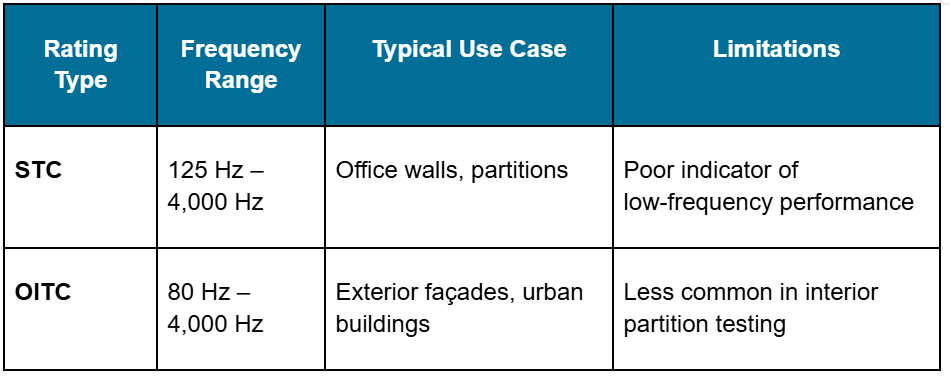
STC measures how effectively walls, floors, and ceilings block airborne sound. It’s calculated across mid-frequency bands (125 Hz to 4,000 Hz) and commonly required to reach STC 50 or higher for offices, schools, and residential builds.
Limitations of STC for Low Frequencies
While STC is useful for general design, it underrepresents low-frequency noise sources—like mechanical hums or traffic—common in urban or utility-heavy environments.
Outdoor-Indoor Transmission Class (OITC)
OITC addresses these lower frequencies (80 Hz to 4,000 Hz), making it more applicable to exterior façades or mixed-use buildings.
Don’t Overlook Flanking Paths
Even with high STC or OITC ratings, sound can bypass assemblies via structural connections—such as floor slabs or ductwork. These indirect paths can degrade performance if not addressed in design.
Why Use Both STC and OITC in Acoustics Design
Comprehensive sound design accounts for both metrics, especially when designing spaces for speech privacy, environmental noise control, or compliance with local ordinances.
Comparison of STC and OITC Acoustic Ratings by Frequency Range and Application
Materials and Geometry in Acoustic Planning
Acoustic outcomes depend heavily on both surface selection and architectural form. Different surfaces produce different sound responses, while the room shape determines how energy is distributed.
How Surfaces Absorb, Reflect, and Diffuse
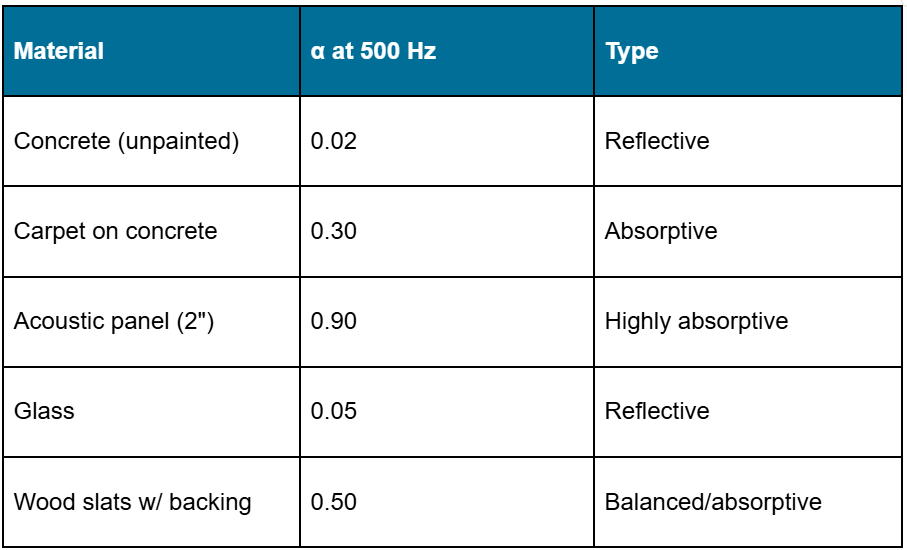
Absorptive materials like acoustical panels reduce reverberation and echo. Reflective materials such as glass bounce sound back, which may increase loudness or distortion. Diffusive surfaces scatter sound energy to prevent hot spots or dead zones. Placement of each must be tailored to room function and user expectation.
Sound Absorption Coefficients (α) of Common Architectural Materials at 500 Hz
Sound Diffusion and Room Balance
While absorption controls reverberation, diffusion helps maintain sound balance across reflective environments.
- Architectural diffusors scatter sound in many directions to reduce spatial echoes and prevent “hot spots” or dead zones.
- These treatments are especially useful in music halls, open-plan offices, and atria where clarity and tonal accuracy must be preserved.
- Modern diffusors—such as quadratic residue or skyline types—are often designed using number-theoretic sequences (e.g., Schroeder diffusors) to operate over broad frequency bands.
Strategic acoustics design places diffusors to prevent sound clustering and improve spatial uniformity across reflective spaces.
The Role of Room Shape in Noise Behavior
Parallel walls may create flutter echoes. Concave ceilings can cause focusing effects. Even corridor layout or ceiling height can influence whether noise builds up or dissipates throughout the space.
Project Type Determines Acoustic Priorities
Each building type requires its own acoustic strategy based on use case and occupancy. What works for a performance venue may fail in a hospital or classroom.
Offices, Classrooms, and Health Facilities
Workspaces require speech privacy and low distraction levels. Schools must maintain intelligibility for instruction. Medical buildings demand quiet zones that meet both patient needs and regulatory thresholds. These spaces benefit from coordinated placement of absorptive panels, blocking elements, and mechanical isolation strategies.
Acoustic zoning also plays a role in neuro-inclusive design by reducing sensory overload. Targeting NC-25 to NC-35 in occupied areas helps maintain focus for users sensitive to background noise, including those with ADHD or auditory processing conditions.
Zoning and Isolation for High-Noise Areas
Mechanical rooms and loud equipment areas should be physically isolated using buffer spaces, high-mass partitions, or vibration-isolated bases. These techniques help protect quieter areas from sound intrusion.
The ABCD Framework for Acoustic Planning
A structured way to approach acoustic control is the ABCD framework: Absorb, Block, Cover, Diffuse. This method helps guide product selection and layout decisions for architects and engineers.
- Absorption reduces reverberation.
- Blocking stops sound transmission between zones.
- Covering introduces masking noise when absolute silence isn’t required.
- Diffusion ensures smooth energy distribution across a space.
- A combination of all four often yields the best results for speech clarity and privacy—especially in multi-function buildings.
Designing for Noise from Mechanical Systems
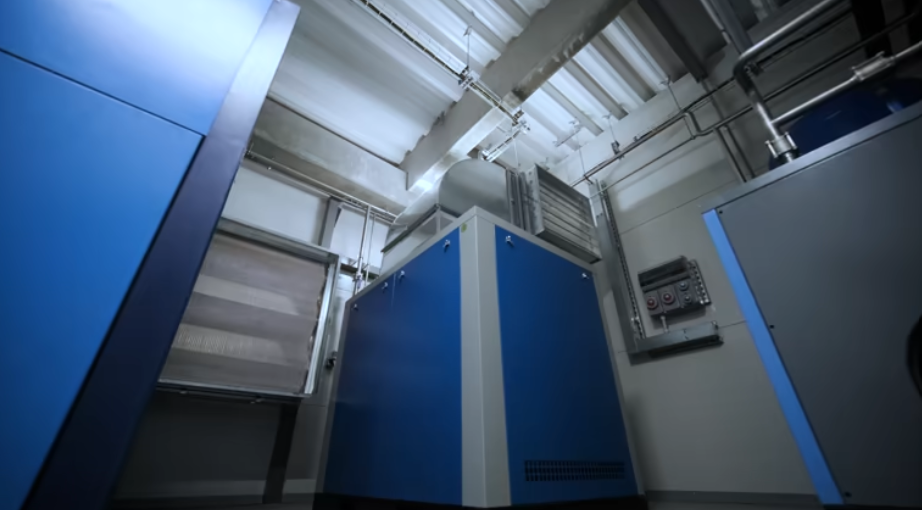
Mechanical equipment is one of the most common sources of disruptive sound in buildings. It must be addressed during early design—not after installation.
Ductborne and Structural Pathways
Noise can travel through ducts, framing, or the air itself. Solutions include flexible connectors, vibration dampers, and isolating equipment from structural members. Systems should be modeled before construction begins to avoid costly retrofits.
Airflow and Pressure Considerations
Silencers reduce noise but must be selected to avoid excessive pressure drop. System-level acoustics design ensures airflow and acoustic performance are balanced from the start.
Structure-Borne Noise and Vibration Control
Mechanical equipment often generates not just airborne noise, but also vibration that travels through the structure. Structure-borne noise can be harder to isolate and often occurs in low-frequency ranges where standard acoustic treatments are less effective.
Solutions include:
- Placing mechanical units on isolation pads or spring hangers
- Decoupling piping and ductwork
- Designing room layouts that separate equipment rooms from sensitive areas
These systems must be integrated into the building structure early, since retrofitting vibration isolation after occupancy can be disruptive and costly.
Exterior Noise Control Through the Envelope
Some building projects require compliance with municipal or campus-wide noise regulations. Exterior noise control demands attention to airborne paths through mechanical openings or façade penetrations.
When to Specify Acoustical Louvers
Acoustical louvers allow airflow while limiting sound transmission through mechanical or exterior wall openings. Internal baffles within the louver absorb and deflect sound energy before it escapes. These units are commonly used in generator enclosures, rooftop equipment screens, and utility buildings. Products are selected based on insertion loss, free area, and airflow resistance to align with both acoustic and ventilation specs.
Using Acoustical Panels to Reduce Interior Reverberation
Acoustical panels absorb airborne sound and reduce reverberation in large or reflective rooms. Installed on ceilings or walls, they help control echo and improve clarity. These panels are selected based on NRC rating, surface area coverage, and compatibility with interior finishes. Their placement is especially effective in open offices, classrooms, and public atriums where absorption must be distributed across multiple surfaces.
Plan for Code Compliance and Measured Performance
Designing with tested acoustic components helps teams meet requirements set by ASHRAE, IBC, and local noise ordinances. Early coordination also reduces the risk of post-construction corrections. From reducing background noise in patient rooms to ensuring speech privacy in offices, thoughtful acoustic design supports both regulatory compliance and functional performance.
To improve building comfort and maintain code alignment, acoustics design should be prioritized in the schematic phase—especially when coordinating with HVAC layouts or structural spans that will carry mechanical noise.
Optimize Louvers and Panels with Dynasonics Engineering Expertise
Dynasonics offers acoustical louvers and acoustical panels engineered to meet demanding acoustic performance targets in mission-critical facilities. Our louvers are tested for insertion loss across octave bands and installed in systems where airflow and noise control must coexist. Our panels are designed to reduce reverberation time and maintain clarity in spaces where sound behavior matters. Contact us today for more information.